Showing posts with label DNA. Show all posts

Thursday, 23 June 2022

Fascinating DNA Evidence Emerges from 79 AD Pompeii

The very first ancient DNA extracted from two bodies recovered from the ruins of Pompeii (which was destroyed in the volcanic eruption of Mount Vesuvius in A.D 79) has revealed that at least one of the individuals in question was either of mixed African or Jewish ancestry.

Above: A picture taken in 1934 of Room 9 of the Casa del Fabbro, with the remains of the skeletons as they were discovered. It was these skeletons which were the subject of the 2022 DNA analysis. (Image from Notizie degli Scavi di Antichità, 1934, p. 286, fig. 10.)  Below, the same scene photographed in 2009.


The DNA discovery, announced in various media outlets, was the product of a study led by Gabriele Scorrano et. al. from the Centre of Molecular Anthropology for Ancient DNA Studies, Department of Biology, University of Rome, titled “Bioarchaeological and palaeogenomic portrait of two Pompeians that died during the eruption of Vesuvius in 79 AD”, and published in the journal Nature Scientific Reports | (2022) 12:6468.

The analysed human remains came from Room 9 of the Casa del Fabbro (Regio I, Insula 10, civic 7), and, the paper states, their “position and orientation are compatible with instantaneous death due to the approach of the high-temperature volcanic ash cloud.”

Of the two skeletons analysed for DNA traces (done by sampling a petrous bone from each individual, and subjecting bone powder to intensive laboratory processes), only one (“Individual A”) produced enough detail for a complete genomic analysis.

Table 1 of that paper provided the completed results:

(“Table 1. Statistic parameters and contamination results of the individuals analysed” can be found on page 3 of the PDF of the article).

Accordingly, the paper reported on the Y-Chromone (male chromosome) result as follows:

“Individual A, albeit at low coverage (Table 1), was found to belong to the Y-chromosome lineage A-M13 (A1b1b2b), a rare lineage absent among ancient individuals from the Italian Peninsula, mainly found in Eastern Africa (~ 40%), but with known occurrences, at much lower frequencies, in the Near East (Turkey, Yemen, Egypt, Palestine, Jordan, Oman and Saudi Arabia).”

“There are only rare and isolated cases of European men belonging to haplogroup A. Commercial tests have identified a few Scottish and Irish families (surnames Boyd, Logan and Taylor) all belonging to the same A1b1b2 (M13) subclade. This subclade is normally found in East Africa (Ethiopia, Sudan), but has also been found in Egypt, the Arabian peninsula, Palestine, Jordan, Turkey, Sicily, Sardinia and Algeria. It was certainly brought to Europe by Levantine people, be it during the Neolithic or later (Phoenicians, Jews, immigration within the Roman Empire.”

The Nature study went on to describe Individual A’s mitochondrial DNA (female chromosome) HV0a as follows:

“The mitochondrial DNA haplogroup . . . revealed that the individual belongs to the haplogroup clade HV0a, the main monophyletic branch of HV0 and subclade of haplogroup HV. This mitochondrial lineage is absent among published Roman Imperial individuals from Italy.”

According to Eupedia, the mitrochondrial DNA HV is“indubitably [a] Middle Eastern haplogroup. 

According to Eupedia, 

“HV is found at a frequency ranging from 4% to 9% in most of the Middle East. Its highest frequency is observed in Iraq and Kurdistan (9%), as well as among the Dargins (9%) of Dagestan, in the north-east Caucasus. HV is unevenly spread around Europe, being extremely rare in Finland, Scandinavia (except Iceland), the British Isles, the Netherlands, Germany, Switzerland, Austria, Albania, and most of Iberia. The highest percentages of haplogroup HV in Europe are observed in Calabria (10%), Sicily (5%), Tuscany (5%), Sardinia (4.5%), Bulgaria (4%), southern Belarus (4%), Croatia (3.5%), Ukraine (3.5%), Iceland (3.5%), Greece (3%), Cyprus (2.5%), and Romania (2.5%).”

The Nature study, in the quotes above, makes great effort to state that neither of the two Haplogroups have been found in contemporary ancient DNA studies undertaken on Roman skeletons.

In other words, both male and female lineages of Individual A were “absent” from DNA recovered from all other comparable Roman Imperial DNA studies — i.e., they were not Romans.

However, as far as the autosomal DNA results go, the paper states that the “genome-wide analyses point out that the Pompeian individual A is genetically close to the extant Mediterranean peoples, mostly to Central Italians and Sardinians.

“It is plausible to think that, thanks to the expansion and the increase in effective population size during the Roman Imperial Age, the Roman genetic pool could have contributed to the nearby populations with a genetic signature that can still be recognized in the extant Mediterranean regions today.”

Furthermore, the autosomal DNA suggests 

“strong affinities with the surrounding central Italian population from the Roman Imperial Age. Our findings suggest that, despite the extensive connection between Rome and other Mediterranean populations, a noticeable degree of genetic homogeneity exists in the Italian peninsula at that time.”

What this suggests, in plain language, is that the individual in question must have had some “foreign”, that is, European, admixture somewhere in his family tree in order to have produced those autosomal DNA results.

Figure 2 of the paper plots the position of Individual A in relation to other population groups:
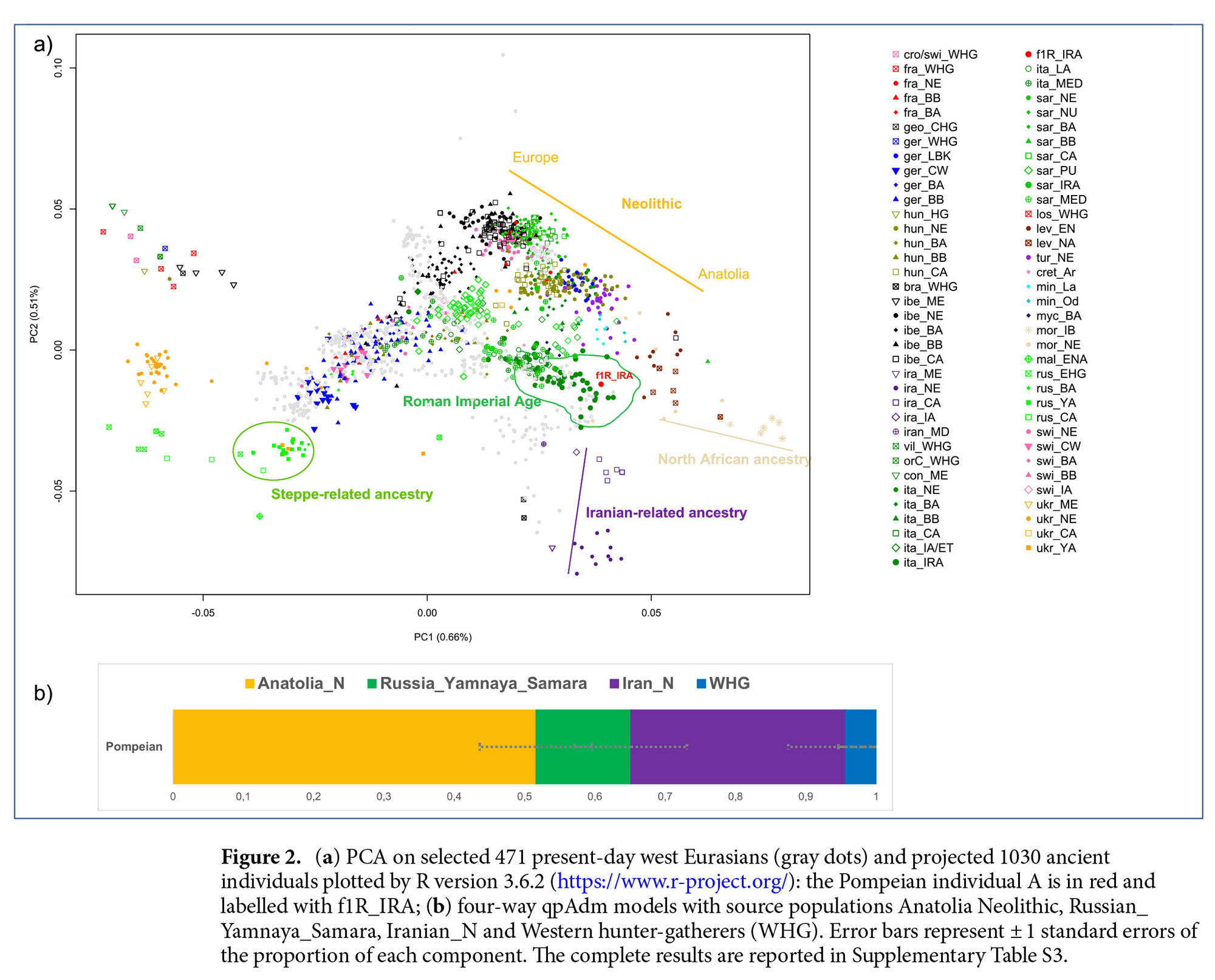

The ultimate conclusion, left unsaid by the paper, is that Individual was not originally Roman, and was of mixed descent, and most likely Jewish in origin.

This conclusion is in line with artistic evidence found elsewhere in Pompeii. For example, the famous portrait of Terentius Neo and his wife, found in his house in Regio 7, Insula 2, 6 in Pompeii, is a clear example of a racially-mixed type from that city.


Terentius Neo and his wife, Pompeii.

Friday, 11 August 2017

Ignorance or Maliciousness? Race, DNA, the Daily Mail and Bledington Village

The Daily Mail has just produced another article—as part of its relentless attacks on the concept of race and the validity of racial differences—which luridly claims that an English village in Gloucestershire is in fact not “British” at all, according to DNA tests—but this claim, is, as usual, based on nothing but ignorance so crushing and obvious that it must be malicious.

The Daily Mail informs its readers that the study was carried out in March by genealogy company Ancestry. The article then helpfully has a video promoting one of that company’s products, confirming that the article is in fact one of the sponsored features for which the Daily Mail is so famous.
Headlined “The English village that's not very English at all!,” the article says that “residents in a Cotswolds community have DNA from 18 different parts of the world despite 95% saying their heritage is white British.”
It then goes on to claim that the residents “have DNA from 18 different places” and that the “average villager's DNA is just 42% British” even though “the last census lists the community as 95 per cent white British.”
The village is, therefore, the article claims, “actually a hotbed of diversity”—and this theme is commonly maintained throughout the article to reinforce the claim, of course, that white British people—and by implication, Europeans general—are all actually racially-mixed and there is no such thing as a “pure” race.
The major claims made with regard to the villagers are as follows:
“Their DNA is from all over the country, with less than half of it coming from Great Britain.”“The DNA breakdown of the average Bledington resident was: Great Britain (Anglo Saxon) 42.54%; Europe West (The region covered today by France and Germany) 20.61%; Ireland/Scotland/Wales 17.03%; Scandinavia 10.06%; Iberian Peninsula (Spain/Portugal) 2.80%; Italy/Greece 1.79%; Europe East 1.66%; European Jewish 1.58%;  Finland/Northwest 1.03%; Caucasus 0.46%; West Asia 0.24%; Asia South 0.11%; Asia Central 0.03%; Africa North 0.03%; Native American 0.01%; Asia East 0.01%; Middle East 0.01%; Melanesia 0.01%.”
It is from these latter statistics that the claim is then manufactured that the villagers “have DNA from all over the world,” and, therefore, they are “not white British” as they think they are.
All of this is, of course, pure nonsense.
Firstly, there is no such thing as “British DNA” in the same way that there is no such thing as a “British race.” To even claim such a thing, is an indication of crushing, dreadful, ignorance.
In this regard, I am reminded of what T. Lothrop Stoddard, the famous American racial scientist wrote in his book, Racial Realities in Europe, namely that “nationality is what people think theyare, race is what they really are.”
There is no “British” race, “French” race, “German” race, or, even for that matter, “Scandinavian” race.
There are, as the science of genetics has confirmed, various races as defined by phenotype and genotype—phenotype by their physical appearance, and genotype by the allele frequency found in their genetic makeup.
Because all humans share the same basic genes, genetic diversity comes about not in the genes per se, but in the frequency, or repetition, of certain alleles, which, the official definition says, are “any of several forms of a gene, usually arising through mutation, that are responsible for hereditary variation.”
Race can be determined by studying these alleles, as all honest geneticists know.
In this way, race is not defined by nationality, but by genetic commonality. It is therefore ridiculous to say that there is a “British race.” There is only a British part of a common European genetic base, which certainly shares its base with the rest of the European gene pool—as do all other European “nations.”
To thus claim that the villagers of Bledington have “mixed ancestry” because their DNA is overwhelmingly European, is to deliberately—and most likely, maliciously, distort the reality of DNA and race.
However, the worst part of the Daily Mail article comes with the non-European ancestry claimed for the villagers of Bledington, and that paper’s trumpeting of this as “evidence” of their “diversity.”
These tiny amounts of non-European DNA (“Caucasus 0.46%; West Asia 0.24%; Asia South 0.11%; Asia Central 0.03%; Africa North 0.03%; Native American 0.01%; Asia East 0.01%; Middle East 0.01%; Melanesia 0.01%”) are what is known in geneticist circles as “Trace DNA”—and are never used to claim ethnicity because they are so small as to be classed as “unreliable.”
The reason for this classification is because of the nature of the common gene pool of humans, which means that almost everyone has some genes in common.
Ancestry—the company which sponsored the Daily Mail article—coyly calls these Trace DNA elements “Low Confidence Regions” for the very reason that the name implies.


In a DNA estimate, low confidence regions are areas for which there's a small amount of DNA evidence found in a sample. All ethnicities with predicted percentages of less than 4.5% appear as low confidence regions.To calculate your ethnicity, we run 40 separate tests on randomly selected portions of your DNA. The bottom number in a range is the smallest amount of an ethnicity that appeared during the 40 analyses, and the top number in a range is the largest amount of an ethnicity that appeared.When an ethnicity has a range that includes zero (meaning that in at least one of the 40 tests, that ethnicity didn’t appear) and doesn’t exceed 15%, or when the predicted percentage is less than 4.5%, the ethnicity is included in an estimate as a low confidence region.The larger the amount of an ethnicity that appears in a test, the more confidence we’re able to attribute to our estimate of that ethnicity. Because low confidence regions are regions for which smaller amounts of evidence appears, our confidence in the percentage of DNA that comes from a low confidence region is necessarily low.


To put this into even plainer English: Ancestry’s DNA tests specifically say that any “ethnicity” test they perform which produces a result of less than 4.5 percent (and as much as 15 percent) is a “low confidence” result—which means that a result of that size cannot be taken as accurate.
Given that this fact is publicly available—and common knowledge among all people who have any knowledge on the topic—it becomes clear that the latest Daily Mail article is either crushingly ignorant, or deliberately misleading.
I think I know which of the two it is.

* Some of the material in this blog post comes from my forthcoming book Race and Racial Differences: A Handbook for the 21st Century.

Tuesday, 24 November 2015

“Ancient Multi-ethnic London” Lies Exposed

New claims by the Museum of London—replicated throughout the controlled media—that London has always been as “ethnically diverse” as it is now are easily disprovable lies being used to justify the ethnic cleansing of the city of white people.

The AFP newswire coverage of the story is a case in point:
A DNA analysis of four ancient Roman skeletons found in London shows the first inhabitants of the city were a multi-ethnic mix similar to contemporary Londoners, the Museum of London said on Monday.


Firstly, they are deliberately confusing ethnicity and race. 

Ethnicity is a cultural term, such as ‘German,’ ‘English,’ ‘Polish,’ or ‘Irish.’ Ethnicity is most often expressed in linguistic boundaries.

Race, however is a genetic term, and all Europeans have genetic commonality. The Museum of London is deliberately mixing up these two meanings to try and create the impression that London has always been racially diverse—when in fact all the evidence shows that it has always been racially homogenous until the advent of present-day Third World immigration.

All Europeans are comprised of a number of genetic strains which came together in three distinct waves, dating from the Paleolithic, Mesolithic, and Indo-European eras, which stretched over 40,000 years in total.

As a result, any investigation of European genetics will find shared DNA, and consequently that European national boundaries are the product of language rather than race.

The existence of common DNA strings in any given European nation does not mean that that nation is ‘ethnically diverse,’ merely that they share a common origin founding population which created Europe.

The claims by the Museum of London that the Roman-founded city’s population was “similar to contemporary Londoners,” does not stand up to the test of history, DNA, or even the ‘new’ analysis of the skeletons now being boasted about in the controlled media.

The new “multi-ethnic” claim is based on DNA-analysis of just four skeletons—hardly a scientifically accepted sample size, bearing in mind that at its height, Roman London had a population of at least 60,000.

Furthermore, of the four skeletons, only one is claimed to have DNA originating outside of Europe—and even that claim is highly dubious.


According to the BBC’s coverage of the “multi-ethnic London” story, the first skeleton, called the “Lant Street teenager,” showed that she “grew up in North Africa” but that her female DNA (mitochondrial DNA, or mtDNA) is common in southern and Eastern Europe. She had blue eyes, the study said.

Then, in a ridiculously unscientific manner, the BBC article claims that there ‘were things about her skeleton that suggested she had some Sub-Saharan African ancestry’—in other words, the claim to what they incorrectly call multi-ethnicity is based upon some unspecified ‘thing’ about the skeleton—while at the same time they say that all the DNA evidence shows that she was European.


In reality, racial skeletal differences are vast and easily discernable to the naked eye, and any expert would have no trouble at all in definitively asserting racial origins based on a study of such a complete skeleton. No ‘suggesting’ would have to be done.

The second skeleton analyzed, known as the “Mansell Street man,” showed that he had dark brown hair and brown eyes. According to the BBC, his “mitochondrial DNA line was from North Africa and his remains show African traits as well.”

The Mansell Street man could well have non-European origins. It is well known that the Roman legions employed mercenaries from all over their empire, and there are recorded instances of some troops stationed along the Hadrian Wall being of non-European, or Middle Eastern, extraction. Their numbers were however tiny, especially when compared to the overall size of the population of Britain.

But, even more importantly, the Museum of London and the controlled media are either being incredibly ignorant, or willfully deceptive by insinuating that the present-day population of North Africa resembled that of 2,000 years ago.

In ancient times, North Africa had a huge original white European presence, known as the ‘old Europeans.’ It was these people who played a major role in creating the Carthaginian civilization, based in present-day Tunisia.

The Carthaginians were early Rome’s greatest enemy, and the famous Punic Wars between Rome and Carthage raged from 264 BC to 146 BC. That was the era of the famous Hannibal of Carthage, who came close to conquering Rome. He was a Carthaginian hero, and coins were issued in his time showing his face—and his European-origin race is clear from these depictions.


The face of Hannibal, Carthage’s greatest warrior, from a silver coin struck at that city around 220 BC.
The Roman province of Africa consisted of a large piece of North African territory, and a vast network of European cities were built up, many of which can be seen to the present day.

Egypt, for its part, after its final collapse into multiracial backwardness around 800 BC, was occupied by the white Macedonians under Alexander the Great in 323 BC.

For the next 275 years, the white Macedonians ruled Egypt in a dynasty known as the Ptolemaic Kingdom. Their last ruler was the most famous queen of all, Cleopatra (actually the seventh queen of that name).

Despite propaganda to the contrary, Cleopatra and the Ptolemaic ruling elite were not African, but European Macedonian. After the fall of Cleopatra, Egypt also came under Roman rule.”

From this understanding of North African history, it is clear that the Roman-era population of North Africa contained a large residual European element. Given the ancient history, it is therefore highly likely that genes found in Europe can also be found among the present day North Africa population.

This does not however mean that a Roman-era skeleton found in London is multiracial—all it means is that some other Romans left similar genes among the gene pool of present-day North Africans.

The third skeleton used as “evidence” by the Museum of London to “prove” London’s “multi-ethnicity” is known as the “Gladiator.” According to the BBC, his mother's ancestral line “is common in Eastern Europe and the Middle East.”


Once again, this is perfectly normal for European mtDNA, which, as the genetic research website Eupedia correctly pointsout, is not as accurate in measuring ethnic ancestry as Y-DNA, or male ancestry is.

In fact, Eupedia even specifically says that in ‘Europe, mtDNA haplogroups are quite evenly spread over the continent, and therefore cannot be associated easily with ancient ethnicities.’


A distribution map of European mtDNA,indicating the continent wide diversity of Europe;s founding maternal population. For the Museum of London to claim that this shows the "ethnic diversity" of Roman London, is laughably ignorant, if not a malicious lie.

Furthermore, the ‘youngest’ mtDNA in Europe which is claimed to have originated in the Middle East, the K1 haplogroup, dates from 12,000 years ago, further casting doubt over any claim of ‘multi-ethnicity, as this gene would have been part of present-day Europe’s founding population.

The fourth and final skeleton used by the Museum of London’s “multi-ethnic” claim is known as the “Harper Road woman,” who had brown hair and brown eyes, but, as the BBC admits, was a native Briton.

This fourth skeleton was clearly one of the Old European R1B haplogroup-Britons, from whom nearly 70 percent of the present-day inhabitants of Britain originate, a figure which rises to 90 percent in Ireland.


R1b distribution in Europe.

In conclusion, it can be seen that of the four skeletons used by the Museum of London and the controlled media to allegedly ‘prove’ how ‘ethnically diverse’ Roman-era London was, only one is possibly of non-European origin.

This is very different to media claims that ‘DNA has confirmed that London was an ethnically diverse city from its very beginnings’ and similar such nonsense. 

On the contrary, London, founded by the Romans, was a European city.

It is clear that the ‘multi-ethnic’ claim is being invented to try and justify the current Third World invasion of London which has turned it into a minority white city in just three decades.

To even suggest that Roman London was as “ethnically diverse” as present-day London, which has large numbers of Bangladeshis, Chinese, Ghanaians, Indians, Jamaicans, Nigerians, Pakistanis, and Turks, is an outright lie.

It is based on a politically-biased ‘interpretation’ given to just one skeleton’s dubious DNA, and is a deliberate deception, presented as fact to justify the ethnic cleansing of white European people fromBritain’s capital city.


Thursday, 13 March 2014

New Study: “A Genetic Atlas of Human Admixture History”

A fascinating new study whose online component has an interactive DNA map has provided a dramatic visual overview of the racial history of selected groups around the world—and has confirmed the essential thesis of March of the Titans.

The new study, titled “A Genetic Atlas of Human Admixture History,” published in Science 14 February 2014: Vol. 343 no. 6172 pp. 747-751 (DOI: 10.1126/science.1243518) says the following in its abstract summary:

“Modern genetic data combined with appropriate statistical methods have the potential to contribute substantially to our understanding of human history.
“We have developed an approach that exploits the genomic structure of admixed populations to date and characterize historical mixture events at fine scales.

“We used this to produce an atlas of worldwide human admixture history, constructed by using genetic data alone and encompassing over 100 events occurring over the past 4000 years.

“We identified events whose dates and participants suggest they describe genetic impacts of the Mongol empire, Arab slave trade, Bantu expansion, first millennium CE migrations in Eastern Europe, and European colonialism, as well as unrecorded events, revealing admixture to be an almost universal force shaping human populations.”

This remarkable study’s online element can be found here, or by clicking on the graphic below.

By clicking on a population group on the map, an automatic display comes up showing the broad genetic compositions of each sample group.

It is important to note that the results are, of course, only based on the returns provided by each sample group, and should not automatically be presumed to be representative of every single individual in that particular group.


Nonetheless, the map essentially proves once again the accuracy of the historical account of racial demographic population shifts, as outlined in March of the Titans.


Tuesday, 14 August 2012

Neanderthals Did Not Interbreed with Humans, Scientists Find


Genetic scientists change their minds again, after earlier announcing that Europeans interbred with Europeans.  Now it seems there was no interbreeding at all, as outlined in a new study from Cambridge university.


From The Telegraph: The genetic traits between humans and Neanderthals are more likely from a shared ancestry rather than interbreeding, a British study has suggested.

Cambridge University researchers concluded that the DNA similarities were unlikely to be the result of human-Neanderthal sex during their 15,000-year coexistence in Europe.

People living outside Africa share as much as four per cent of their DNA with Neanderthals, a cave-dwelling species with muscular short arms and legs and a brain slightly larger than ours.

The Cambridge researchers examined demographic patterns suggesting that humans were far from intimate with the species they displaced in Europe almost 40,000 years ago.

The study into the genomes of the two species, found a common ancestor 500,000 years ago would be enough to account for the shared DNA.

Their analysis, published in the journal Proceedings of the National Academy of Sciences (PNAS), contradicts recent studies that found inter-species mating, known as hybridisation, probably occurred.

Dr Andrea Manica, who led the study, said: "To me the interbreeding question is not whether there was hybridisation but whether there was any hybridisation that affected the subsequent evolution of humans. I think this is very, very unlikely.

"Our work shows clearly the patterns currently seen in the Neanderthal genome are not exceptional, and are in line with our expectations of what we would see without hybridisation.

"So, if any hybridisation happened then it would have been minimal and much less than what people are claiming now."

Evidence has shown that Neanderthals were driven into extinction by humans who were more efficient at finding food and multiplied at a faster rate.

A previous study in 2010 suggested that interspecies liaisons near the Middle East resulted in Neanderthal genes first entering humans 70,000 years ago.

Modern non-Africans share more with Neanderthals than Africans, supporting the claim that the mixing occurred when the first early humans left Africa to populate Europe and Asia.

The existence of a 500,000-year-old shared ancestor that predates the origin of Neanderthals provides a better explanation for the genetic mix.

Diversity within this ancestral species meant that northern Africans were more genetically similar to their European counterparts than southern Africans through geographic proximity.

This likeness persisted over time to account for the overlap with the Neanderthal genome we see in modern people today.

Differences between populations can be explained by common ancestry, Dr Manica said.

"The idea is that our African ancestors would not have been a homogeneous, well-mixed population but made of several populations in Africa with some level of differentiation, in the way right now you can tell a northern and southern European from their looks," she said.

“Based on common ancestry and geographic differences among populations within each continent, we would predict out of Africa populations to be more similar to Neanderthals than their African counterparts – exactly the patterns that were observed when the Neanderthal genome was sequenced, but this pattern was attributed to hybridisation.

"Hopefully, everyone will become more cautious before invoking hybridisation, and start taking into account that ancient populations differed from each other probably as much as modern populations do.”

Northern Africans would be more similar to Europeans and ancient similarity stayed because there wasn't enough mixing between northern and southern Africans.

Population diversity, known as substructure, cant explain data on the shared genes, said David Reich, a professor of genetics at Harvard Medical School, in Boston who authored the 2010 study.

We have ruled out the possibility that ancient substructure can explain all the evidence of greater relatedness of Neanderthals to non-Africans than to Africans, he added.

Dr Manica said hybridisation between Neanderthals and humans can never be disproved entirely. 

Thursday, 12 July 2012

Genes "May Play Role in Educational Achievement"


Researchers have identified genetic markers that may influence whether a person finishes high school and goes on to college, according to a national longitudinal study of thousands of young Americans.


The study is in the July issue of Developmental Psychology, a publication of the American Psychological Association.

"Being able to show that specific genes are related in any way to academic achievement is a big step forward in understanding the developmental pathways among young people," said the study's lead author, Kevin Beaver, PhD, a professor at the College of Criminology and Criminal Justice at Florida State University.

The three genes identified in the study -- DAT1, DRD2 and DRD4 -- have been linked to behaviors such as attention regulation, motivation, violence, cognitive skills and intelligence, according to the study.

Previous research has explored the genetic underpinnings of intelligence but virtually none has examined genes that potentially contribute to educational attainment in community samples, said Beaver.

He and his colleagues analyzed data from the National Longitudinal Study of Adolescent Health, also known as Add Health. Add Health is a four-wave study of a nationally representative sample of American youths who were enrolled in middle or high school in 1994 and 1995.

The study continued until 2008, when most of the respondents were between the ages of 24 and 32. The participants completed surveys, provided DNA samples and were interviewed, along with their parents. The sample used for this analysis consisted of 1,674 respondents.

The genes identified in this research are known as dopamine transporter and receptor genes. Every person has the genes DAT1, DRD2 and DRD4, but what is of interest are molecular differences within the genes, known as alleles, according to Beaver. 

Subjects who possessed certain alleles within these genes achieved the highest levels of education, according to the findings.

Dopamine transporter genes assist in the production of proteins that regulate levels of the neurotransmitter dopamine in the brain, while dopamine receptor genes are involved in neurotransmission. Previous research has shown that dopamine levels play a role in regulating impulsive behavior, attention and intelligence.

The presence of the alleles alone did not guarantee higher levels of education, the study found. Having a lower IQ was more strongly associated with lower levels of education. Also, living in poverty and essentially "running with a bad crowd" resulted in lower levels of education despite the genetic effects.

Even though the genetic variants were found to be associated with educational levels, having a specific allele does not determine whether someone will graduate from high school or earn a college degree, according to Beaver.

Rather, these genes work in a probabilistic way, with the presence of certain alleles simply increasing or decreasing the likelihood of educational outcomes, he said.

"No one gene is going to say, 'Sally will graduate from high school' or 'Johnny will earn a college degree,'" he said.

"These genetic effects operate indirectly, through memory, violent tendencies and impulsivity, which are all known predictors of how well a kid will succeed in school. If we can keep moving forward and identify more genetic markers for educational achievement, we can begin to truly understand how genetics play a role in how we live and succeed in life."

Monday, 9 July 2012

Oldest “Modern Human” DNA Extracted from “Caveman” Bones in Spain—Linked to Northern European populations


Scientists have extracted DNA from 7,000 year old “caveman” bones found in Spain and genetically matched them to modern northern European populations.

Previously, the oldest modern human genomes yet recovered yet came from Ötzi the Iceman, a 5,300-year-old mummy found in the Alps in 1991. 

Researchers have salvaged DNA from even older human cells, but this comes from the mitochondria that generate energy for our bodies, and not from the nucleus where our chromosomes are housed. (Mitochondrial DNA is passed down only by mothers.)

Now researchers have rescued fragments of genomes from the remains of two cavemen unearthed in northern Spain.

"These are the oldest partial genomes from modern human prehistory," researcher Carles Lalueza-Fox, a paleogeneticist at the Spanish National Research Council, was quoted as saying.

The skeletons of two young adult males were discovered by chance in 2006 by cave explorers in a cavern high in the Cantabrian mountain range, whose main entrance is found at 4,920 feet (1,500 meters) altitude. Winters there are notably cold, which helped preserve the DNA in the bones.

These bones date back to the Mesolithic period, before agriculture spread to the Iberian Peninsula with Neolithic settlers from the Middle East. These cavemen were hunter-gatherers, judging by the ornament that one was found with of red-deer canines embroidered onto a cloth.

The scientists recovered 1.34 percent and 0.5 percent of the human genomes from the bones of these two cave men. Analyses revealed that current populations of the Iberian Peninsula, which includes Spain, Portugal and Andorra, are not genetically linked with these ancient hunter-gatherers. Instead, these cavemen were closer genetically to the current populations of northern Europe.

"There are many works that claim the Basques [of the Iberian Peninsula] could be descendants from Mesolithics that became isolated in the Basque country," Lalueza-Fox said. "We found the modern Basques are genetically not related to these two individuals."

The scientists also recovered the complete mitochondrial DNA of one of these cavemen. This revealed that European populations during the Mesolithic were very uniform genetically.

"Despite their geographical distance, individuals from the regions corresponding to the current England, Germany, Lithuania, Poland and Spain shared the same mitochondrial lineage," Lalueza-Fox said. "These hunters-gatherers shared nomadic habits and had a common origin."

The researchers now aim to complete the genomes of both cavemen. Such data could help "explore genes that have been modified with the arrival of the Neolithic in the European populations," Lalueza-Fox said.

Friday, 4 May 2012

'Iceman Ötzi': Oldest Blood

New reports have announced that the mummy of the 5,300-year-old "Iceman" mummy of the Alps, named Ötzi, lived for some time after being shot in the back by an arrow, scientists said on Tuesday after using forensic technology to analyse his preserved blood.
Contrary to a leading theory, Ötzi did not expire immediately from his wounds, they reported in the Journal of the Royal Society Interface, published by Britain's academy of sciences.
Scientists led by Albert Zink of the Ludwig Maximilian University in Munich, southern Germany used nano-scale methods to probe the oldest blood known to modern science, preserved by thousands of years of alpine chill.
Using a so-called atomic force microscope able to resolve images just a few nanometers (billionths of a metre) across, they identified corpuscles with the classic doughtnut shape of healthy blood cells.
"To be absolutely sure that we were not dealing with pollen, bacteria or even a negative imprint of a blood cell, but indeed with actual blood cells, we used a second analytical method," Zink said.
They deployed Raman spectroscopy, in which refracted light from a laser beam gives chemical clues about a sample.
This showed the presence of haemoglobin and fibrin, which are key components in blood clotting, at the arrow wound on Ötzi's back.
"Because fibrin is present in fresh wounds and then degrades, the theory that Ötzi died straight after he had been injured by the arrow, as had once been mooted, and not some days after, can no longer be upheld," Zink said.
Ötzi's remains were discovered by two German hikers in September 1991 in the Oetztal Alps in South Tyrol, northern Italy, 3,210 metres (10,500 feet) above sea level.
Scientists have used high-tech, non-invasive diagnostics and genomic sequencing to penetrate his mysterious past.
These efforts have determined Ötzi died around the age of 45, was about 1.60 metres (five foot, three inches) tall and weighed 50 kilos (110 pounds).
He suffered a violent death, with an arrow severing a major blood vessel between the rib cage and the left scapula, as well as a laceration on the hand.
A group of scientists have sequenced Ötzi's full genome and the report was published in  February 2012. In that report, the scientists said: “We present indications for recent common ancestry between the Iceman and present-day inhabitants of the Tyrrhenian Sea, that the Iceman probably had brown eyes, belonged to blood group O and was lactose intolerant. “